The High Cost of Employee Attrition in the Contact Center Industry
Employee attrition continues to be a significant challenge for the contact center industry, resulting in substantial costs and operational disruptions. Despite the attractiveness of offshoring destinations like India and the Philippines, contact centers experience alarmingly high turnover rates, reaching up to 80% and 60% respectively (Presbitero et al., 2021). This article explores the reasons behind the persistently high cost of employee attrition in the contact center industry and its implications.
Factors Contributing to High Attrition Rates
Several factors contribute to the high attrition rates in contact centers. The availability of a low-cost workforce in offshoring destinations initially attracts companies to establish their operations there. However, talent shortages and wage increases threaten this competitive advantage, leading to higher attrition rates (Thite, 2010).
Additionally, work organization and employment branding play a crucial role in employee retention. Dissatisfaction with pay, limited career advancement opportunities, and inadequate work organization contribute to attrition (Thite, 2010). The high-stress nature of contact center work, including customer aggression, further exacerbates attrition rates (Bi et al., 2021).
The research on customer mistreatment and its link to employee turnover adds an important layer to this picture. It’s not just that the work is demanding — it’s that agents face regular interpersonal hostility from the customers they serve, with limited protection or recovery mechanisms built into how most operations are structured. The emotional labor required to remain professional under those conditions is a significant driver of exhaustion and eventual departure.
Impact of High Attrition
The high cost of employee attrition in the contact center industry has significant implications for organizations. Rapid employment growth combined with high attrition results in low employee tenure, with a majority of the workforce having less than one year of seniority (Thite & Russell, 2010). This constant turnover leads to a loss of valuable knowledge and unrecouped financial investments for organizations (Iwu et al., 2021). Moreover, the quality of service provided to customers is compromised due to the constant influx of new employees (Piramanayagam & Seal, 2021).
To illustrate the significant financial impact of the cost of attrition on your contact center operation, leverage the WFM Labs attrition simulator.
The True Cost Accounting
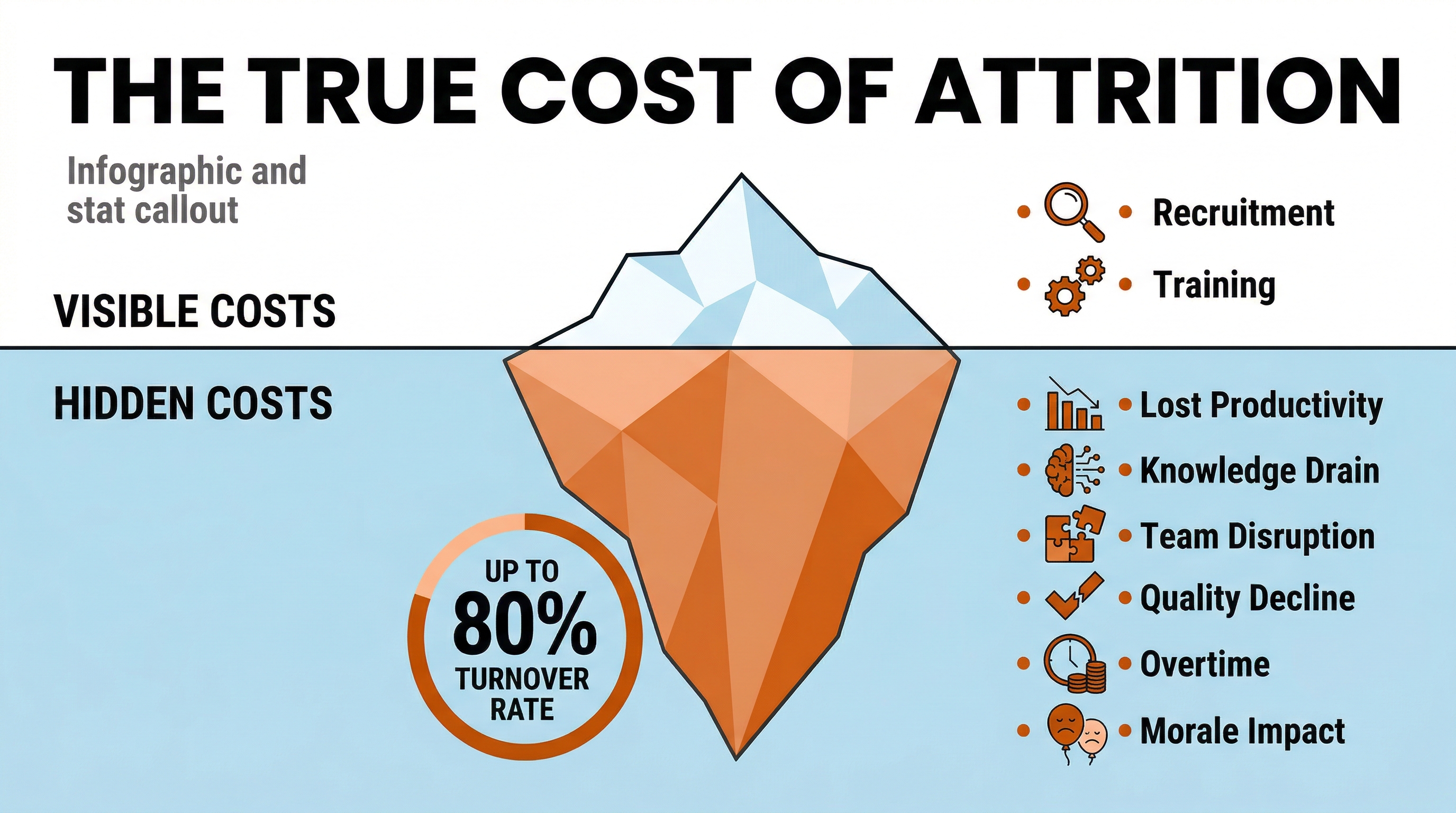
Organizations that track only the direct, visible costs of attrition — recruiting fees, HR time, training costs — significantly undercount the real impact. The full picture includes:
Direct replacement costs — Job posting, recruiter time or agency fees, screening and interviewing, pre-employment assessments, background checks, and onboarding administration. These are the costs most organizations track.
Training and ramp costs — New agent training in most contact centers runs 4 to 12 weeks before an agent handles production volume. Even then, new agents typically require 3 to 6 months to reach full proficiency. During that ramp period, handle times are elevated, first contact resolution rates are lower, and quality scores lag. The productivity gap between a new hire and a tenured agent is real and measurable.
Knowledge loss — Experienced agents carry institutional knowledge that isn’t documented anywhere: which escalation paths actually work, how to navigate ambiguous policy situations, how to de-escalate specific customer archetypes. That knowledge disappears with each departure and has to be rebuilt from experience — a process that takes months and reduces service quality in the interim.
Service quality degradation — Higher proportions of inexperienced agents in the workforce correlate with higher handle times, lower first contact resolution, more escalations, and lower customer satisfaction scores. The Service-Profit Chain research makes clear that employee tenure and capability directly influence the customer experience — and customer experience influences retention and revenue.
Supervisory absorption — A high-turnover operation consumes disproportionate supervisor capacity. Supervisors who would otherwise be coaching and developing experienced agents instead spend their time onboarding new hires, managing performance issues among low-tenure agents, and handling the increased escalation volume that comes with an inexperienced workforce. This creates a supervisory quality deficit that perpetuates the cycle.
The Burnout-to-Attrition Pathway
Attrition doesn’t typically arrive without warning. The research on solving agent attrition describes a well-documented pathway: elevated job demands combine with insufficient job resources, producing first emotional exhaustion, then depersonalization, then disengagement, and finally departure. Each stage is detectable before the next one develops — if organizations have the diagnostic frameworks and data to look.
Mental wellbeing research identifies the specific factors that buffer against this progression: emotional intelligence, sense of meaningfulness, access to social support, and autonomy. These aren’t soft amenities — they are the resources that allow agents to do demanding work sustainably. Organizations that strip these resources in pursuit of efficiency (maximizing occupancy, cutting coaching, increasing monitoring intensity) are accelerating the burnout-to-attrition pathway even as they temporarily reduce costs.
The research on microbreaks offers a concrete example: brief recovery periods during shifts reduce fatigue and improve vigor. The operational cost is minimal. The benefit in terms of sustained performance and reduced exhaustion is measurable. Yet many high-occupancy operations squeeze out break time in the name of efficiency, trading a small short-term gain for accelerated burnout risk.
What the WFM Function Controls
Workforce management practitioners hold more attrition-relevant levers than is commonly recognized. Scheduling design, occupancy targets, adherence management approach, and the reliability of off-phone activity commitments (coaching, training, development) are all WFM decisions with direct consequences for the agent experience.
Understanding where your organization sits on the WFM maturity curve helps clarify which of these levers are currently operable. Organizations at lower maturity levels often lack the data visibility and process infrastructure to use these levers proactively — they find out about attrition risk from exit interviews rather than from leading indicators in their workforce data.
The Collaborative Intelligence Framework developed by WFM Labs addresses this at a structural level: building operations that are both efficient and sustainable for the human workforce within them is not a values choice — it is a precondition for achieving long-term performance objectives.
Addressing the Challenge
To mitigate the high cost of employee attrition, contact centers need to focus on several key areas:
- Improving pay satisfaction and providing longer-term career advancement opportunities can enhance employee retention (Thite, 2010).
- Implementing effective work organization strategies, such as workload management and employee empowerment, can reduce stress and improve job satisfaction (Bi et al., 2021).
- Creating a positive work environment and fostering a customer-centric culture can enhance employee engagement and reduce attrition (Mukherjee & Maheshwari, 2014).
- Building early warning systems using workforce data to detect burnout precursors before they advance to departure intent.
- Honoring development commitments — ensuring that coaching and training are delivered reliably, not routinely sacrificed during volume variance.
Conclusion
The contact center industry continues to grapple with the challenge of high employee attrition, resulting in significant costs and operational disruptions. Factors such as talent shortages, wage increases, and inadequate work organization contribute to this issue. The high turnover rates have implications for organizational knowledge loss and compromised service quality.
To address this challenge, contact centers must focus on improving pay satisfaction, providing career advancement opportunities, and implementing effective work organization strategies. By prioritizing employee retention, contact centers can reduce costs and enhance operational efficiency. The organizations that treat attrition as a WFM problem — not just an HR problem — and build the operational frameworks to manage its structural drivers will achieve measurably better outcomes.
References
Mukherjee, A. & Maheshwari, S. (2014). Customer-centric culture for total quality in service organisations. Journal of Quality in Maintenance Engineering, 20(2), 146-157.
Presbitero, A., Roxas, B., & Chadee, D. (2021). Looking beyond HRM practices in enhancing employee retention in BPOs: focus on employee–organisation value fit. The International Journal of Human Resource Management, 27(6), 635-652.
Thite, M. (2010). Managing people in the new economy. SAGE Publications.
Thite, M. & Russell, B. (2010). The next available operator: managing human resources in indian business process outsourcing industry. SAGE Publications.
Iwu, C., Opute, A., Aliyu, O., Eresia-Eke, C., Musikavanhu, T., & Jaiyeola, A. (2021). A structural equation modelling evaluation of antecedents and interconnections of call centre agents’ intention to quit. Journal of Risk and Financial Management, 14(4), 179.
Bi, X., Liu, Y., & Zhao, Y. (2021). Impact of customer aggression on employee turnover intentions: evidence from the banking industry. Frontiers in Psychology, 12.
Piramanayagam, S. & Seal, P. (2021). Relationship between employee satisfaction, HR practices and service quality of employees. Frontiers in Psychology, 12.