Solving Agent Attrition
Agent burnout is a significant issue that affects various industries, including contact centers. Burnout is characterized by emotional exhaustion, depersonalization, and diminished personal accomplishment — and it has detrimental effects on both individuals and organizations.
Understanding Burnout in Contact Centers
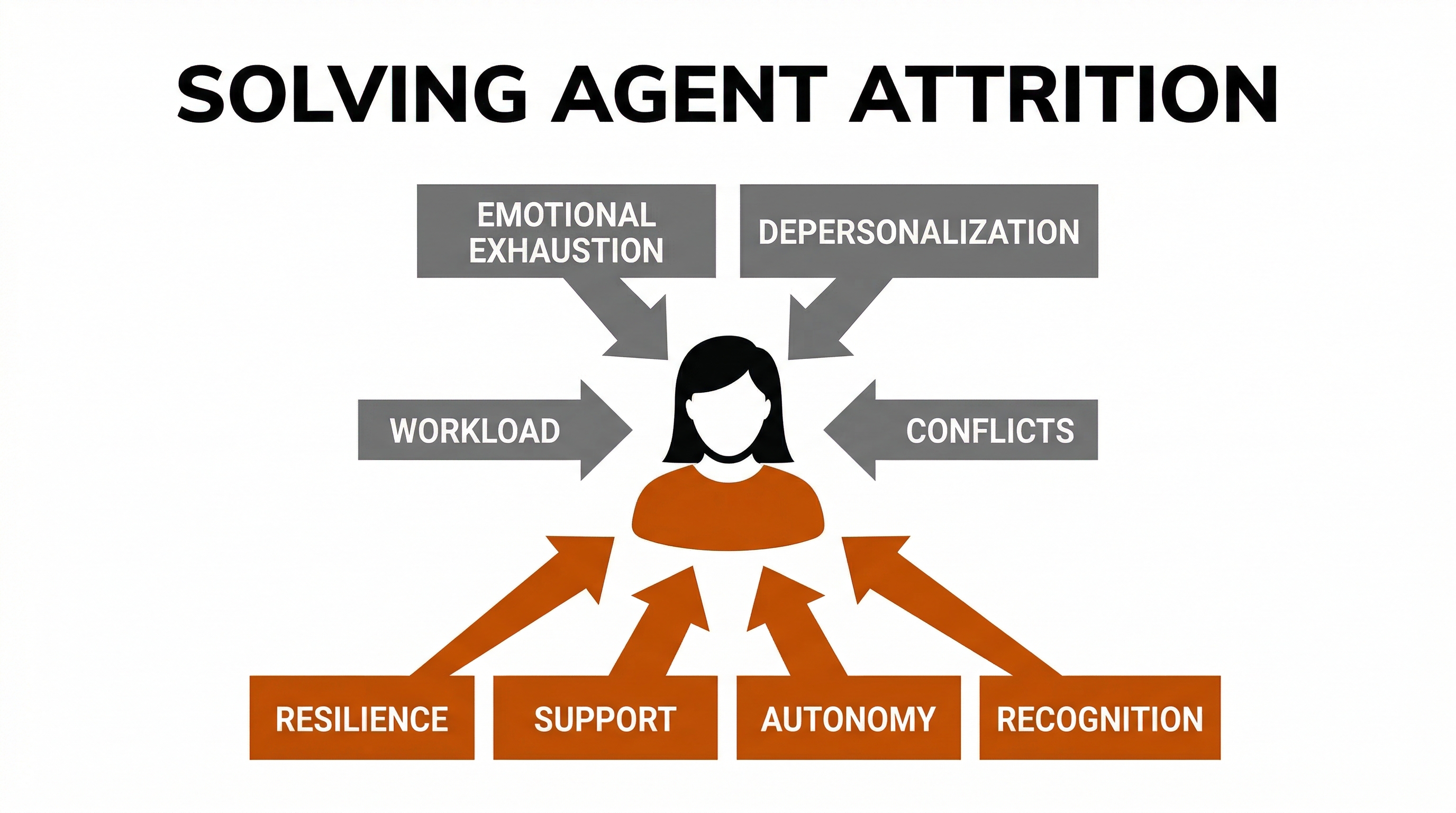
It is important to address burnout in contact centers because it can lead to decreased job satisfaction, increased turnover rates, and reduced productivity (Chambel et al., 2021). To combat burnout, interventions should focus on increasing job relational characteristics and promoting positive work outcomes (Gonçalves et al., 2019). Tailored programs of intervention are necessary, especially during challenging times such as the COVID-19 pandemic, which has further exacerbated burnout among contact center workers (Răducu & Stănculescu, 2022).
Understanding the factors that contribute to burnout is crucial for developing effective strategies to prevent and mitigate its impact. Job demands — such as emotional labor, intensity/variety, and customer contact — have been found to increase burnout, while job resources — such as social support and autonomy — decrease it (Kim & Wang, 2018). Therefore, organizations should prioritize creating a supportive work environment and providing resources to help employees cope with the demands of their job.
High occupancy is one of the most consistently identified structural drivers of burnout in contact center research. When agents spend the majority of their paid time in back-to-back interactions with little recovery time, the cumulative depletion of emotional and cognitive resources is measurable — and predictable. Managing occupancy targets thoughtfully is one of the most direct levers organizations have for preventing burnout before it reaches the point of departure.
The Role of Customer Interactions in Burnout
An often-underappreciated contributor to agent attrition is customer mistreatment. The research on the hidden link between customer mistreatment and employee attrition establishes a clear causal pathway: employees who experience interpersonal injustice from customers develop negative emotional responses, which accumulates into emotional exhaustion, which accelerates voluntary turnover.
What makes this finding operationally useful is the moderating role of supervisor behavior. When supervisors treat employees fairly and provide socioemotional support, the negative effects of customer mistreatment are attenuated. This gives organizations a concrete intervention point: supervisor training and accountability for fair treatment is not just an HR nicety — it’s an attrition-reduction strategy with measurable ROI.
The mental wellbeing research reinforces this from a different angle: emotional intelligence and sense of meaningfulness function as protective resources against burnout. Organizations that invest in developing these qualities in their workforce — through structured coaching, meaningful work design, and recognition — are building burnout resilience into the operation, not just reacting to it.
The Financial Stake
The scale of the attrition problem makes this more than a people issue. The high cost of employee attrition in the contact center industry documents turnover rates reaching 80% in some offshore markets and the compounding costs of replacement: recruiting, onboarding, training, and the extended ramp time before new agents reach full productivity. Industry estimates consistently put the total cost of replacing a frontline agent between 50% and 200% of annual salary.
For a contact center with 500 agents and 40% annual turnover, that translates to replacing 200 agents per year. At a conservative $15,000 per replacement, that’s $3 million annually — a number that makes almost any retention investment look favorable.
More importantly, the problem is solvable. Attrition is not a fixed feature of the contact center industry. Organizations that have addressed the structural drivers — occupancy, supervisor quality, development investment, work design — achieve substantially lower turnover than their peers. The difference is not luck or culture; it’s deliberate policy.
Workforce Management as a Prevention System
The WFM function holds more attrition-prevention levers than most organizations realize:
Scheduling design — Schedules that honor work-life preferences, provide consistent shift patterns, and build adequate recovery time are associated with lower turnover. Erratic or last-minute schedule changes signal to agents that their personal time has no value.
Coaching and development access — When training and coaching commitments are routinely sacrificed during volume spikes, agents receive a clear message: their development doesn’t matter when it’s inconvenient. Automation-enabled dynamic scheduling can change this — delivering coaching in pockets of available capacity rather than requiring pre-planned blocks that get cancelled.
Adherence management — How adherence is tracked and enforced shapes the supervisor-agent relationship significantly. Punitive, surveillance-heavy adherence management is associated with disengagement. Coaching-based approaches that treat adherence variances as conversations rather than infractions have better outcomes.
Early warning signals — Data-driven WFM operations can detect attrition risk before agents actually leave. Schedule adherence deterioration, increasing absenteeism, handle time changes, and declining customer satisfaction scores all tend to shift before a resignation letter arrives. Building detection systems around these leading indicators allows for intervention at a stage when retention is still possible.
Understanding where your organization sits on the WFM maturity curve shapes how far along this path is achievable. Organizations operating at foundational maturity levels often lack the data infrastructure and process discipline to run early warning systems or deliver dynamic coaching. Building toward higher maturity isn’t just about operational efficiency — it’s about creating the capability to keep the people you’ve invested in.
The WFM Labs Approach
At WFM Labs, we recognize agent burnout is a complex issue that requires attention in contact centers. By implementing new and innovative processes, leveraging AI, and the massive data sets generated by contact centers, we can identify factors that contribute to burnout among contact center employees. It is important for organizations to implement both detection and intervention mechanisms that focus on increasing job relational characteristics, promoting positive work outcomes, and providing resources to help employees cope with job demands.
By advancing our technology and processes, workforce management can play a lead role in addressing burnout. The Collaborative Intelligence Framework provides the structural approach — organizing human and AI capabilities to create operations that are both efficient and sustainable for the people working within them. Adopting next-generation WFM practices will lead to improved employee well-being, job satisfaction, and overall organizational performance.
References
Leiter, M. and Maslach, C. (1988). The impact of interpersonal environment on burnout and organizational commitment. Journal of Organizational Behavior, 9(4), 297-308.
Fulaedzah, I. (2022). Burnout on contact center: a literature review. Interdisciplinary Social Studies, 1(4), 383-402. Link
Gonçalves, C., Chambel, M., & Carvalho, V. (2019). Combating burnout by increasing job relational characteristics. Journal of Career Development, 47(5), 538-550.
Chambel, M., Carvalho, V., Lopes, S., & Cesário, F. (2021). Perceived overqualification and contact center workers’ burnout: are motivations mediators?. International Journal of Organizational Analysis, 29(5), 1337-1349.
Kim, S. and Wang, J. (2018). The role of job demands–resources (jdr) between service workers’ emotional labor and burnout: new directions for labor policy at local government. International Journal of Environmental Research and Public Health, 15(12), 2894.
Răducu, C. and Stănculescu, E. (2022). Personality and socio-demographic variables in teacher burnout during the covid-19 pandemic: a latent profile analysis. Scientific Reports, 12(1).