Setting the Right Forecast Accuracy Target
The Challenge of Setting the Right Target
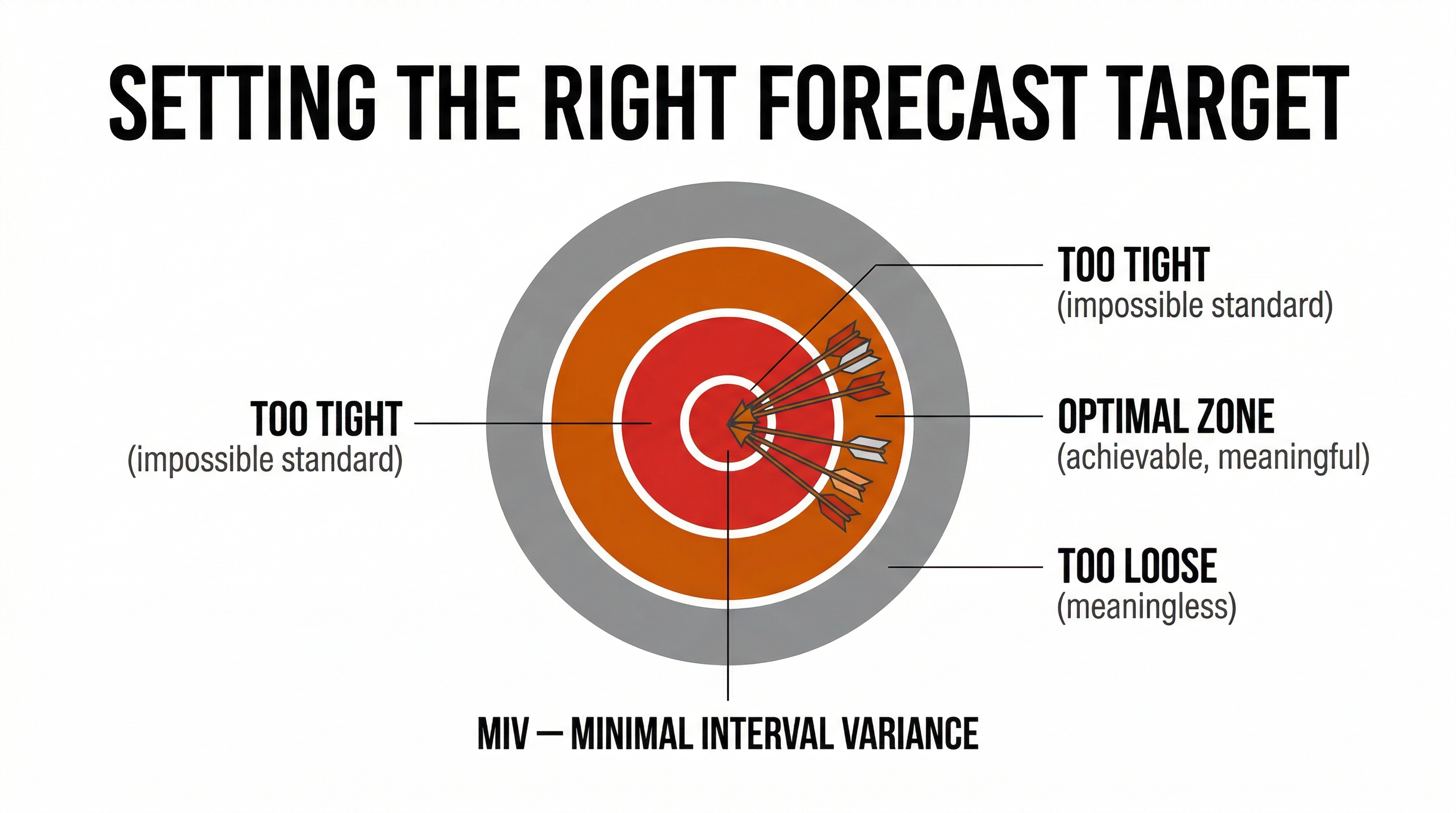
Setting the proper forecast accuracy target is a pivotal task in any business that aims for optimum productivity and cost-effectiveness. However, defining that goal may not be as clear as one might think.
Companies need to strike a delicate balance. Many organizations have goals arbitrarily set — perhaps by a previous leader — and may lack clarity on the logic behind how the goal was established.
Introducing Minimal Interval Variance
The key to avoiding these pitfalls is effectively calibrating your forecast accuracy target. One way to examine whether your forecast accuracy target is too conservative or aggressive is by leveraging Minimal Interval Variance (MIV).
Minimal Interval Variance (MIV) is a statistical concept that examines the most granular calls offered at your lowest interval level (usually 15 or 30 minutes). It’s an invaluable calculation that provides critical insights into your operation’s inherent variability. Comparing your target forecast accuracy with your MIV gives you a more realistic perspective of your staffing needs while accounting for unexpected variability in workload.
The WFM Labs Simulation Tool
We have developed a simulation tool at WFM Labs to aid in your forecast accuracy calibration process. Our tool simulates different scenarios by comparing your forecast accuracy target or goal with the minimal interval variance. It leverages assumptions built on your hours of operation and the number of calls offered, giving you a basis and insights into whether your goal may be too aggressive, conservative, or well calibrated.
By comparing your forecast accuracy goal with the MIV using our tool, you can better align your goals with reality:
- A significant positive deviation may indicate your forecast accuracy is too conservative — suggesting you could afford to aim for tighter accuracy
- A negative deviation might imply an over-ambitious or even impossible forecast accuracy target, urging you to reconsider and set more achievable goals
Why Forecast Accuracy Targets Matter Beyond the Math
Getting the accuracy target right isn’t just a statistical exercise — it has direct operational consequences. A target that’s too aggressive creates a culture of constant perceived failure. Forecasters hit 90% accuracy on a target of 95% and get flagged for underperformance, even when 90% accuracy was the mathematical ceiling given the natural variability of the business. This erodes morale, invites gaming of the metrics, and draws attention away from genuine improvement opportunities.
A target that’s too loose has the opposite problem. When a 75% accuracy goal is easily achievable without effort, forecasters have no incentive to invest in better models, cleaner data, or tighter processes. Organizational inertia sets in, and the forecast function stagnates — even as call patterns grow more complex and AI-driven channel shifts create new demand dynamics.
The evolving landscape of forecasting in contact centers reinforces this point. As contact centers move from fixed algorithms toward machine learning and ensemble methods, the baseline accuracy ceiling changes — and targets must be recalibrated accordingly. A target set when your organization was using simple exponential smoothing will be either obsolete or arbitrary once you’ve deployed a more sophisticated forecasting engine.
From Accuracy to Adaptability
There’s a broader principle at work here that practitioners often miss: forecast accuracy is a means, not an end. The real objective is workforce management outcomes — service levels met, costs controlled, agents neither overloaded nor underutilized.
That means forecast accuracy targets should be evaluated in the context of how much your operation can adapt to forecast error in real time. An organization with strong real-time flexibility — automation, empowered supervisors, dynamic scheduling — can absorb more forecast error than one that is rigidly tied to the pre-planned schedule. The Flexibility Index concept developed by WFM Labs formalized exactly this relationship: the more adaptable your operation, the less catastrophic a 5% miss becomes.
This also connects to the simulation approach described in Leverage Simulation to Improve Capacity Planning. Monte Carlo methods can model forecast error distributions alongside operational variability, giving planners a probabilistic view of outcomes rather than a false precision. Building that uncertainty into the planning model is more honest — and more useful — than chasing a point estimate.
Practical Steps for Calibrating Your Target
If your organization hasn’t formally evaluated whether your forecast accuracy target is well-calibrated, here is a practical starting point:
- Measure your MIV at the interval level for a representative 90-day period, broken out by queue and time of day if possible
- Compare your current accuracy against MIV — not against an arbitrary percentage
- Assess your operational flexibility — how much error can you absorb in real time before service levels are materially impacted?
- Set the target accordingly — tight enough to drive improvement, loose enough to be achievable given inherent variability
- Review annually, or whenever you materially change your forecasting models, channel mix, or operational structure
Organizations that work through this process typically find that their existing accuracy targets were set without reference to any of these factors — which explains why so many contact center forecasting functions feel permanently stuck in failure mode.
Understanding where your WFM function sits on the maturity curve is also instructive here. Forecasting maturity is one of the key dimensions assessed in the WFM Maturity Model, and most organizations at the foundational levels have never formally evaluated whether their accuracy targets are grounded in the mathematics of their own operation.
Finding the Right Balance
Correct calibration of forecast accuracy goes a long way in maximizing productivity and growth. At WFM Labs, we aim to provide you with the tools and insights you need to better understand and manage your staffing needs, helping you excel in workforce management.
By leveraging Minimal Interval Variance and our simulation tool, you have a better chance to find the right balance in your forecast accuracy goals — positioning your business for sustainable success.