Leverage Simulation to Improve Capacity Planning
Monte Carlo simulation is a powerful tool that can be leveraged to improve forecast outcomes and enhance capacity planning for contact centers. Traditionally, contact centers rely on fixed inputs for call volume, handle time, shrinkage, occupancy, and attrition to plan their overall capacity. However, these fixed inputs may not accurately capture the uncertainties and variability inherent in the contact center environment. By using Monte Carlo simulation, contact centers can incorporate a range of inputs and statistical distributions to generate a range of outputs for the full-time equivalent (FTE) required to serve the demand (Roh et al., 2009).
Simulating Uncertainty in Long-Term Planning
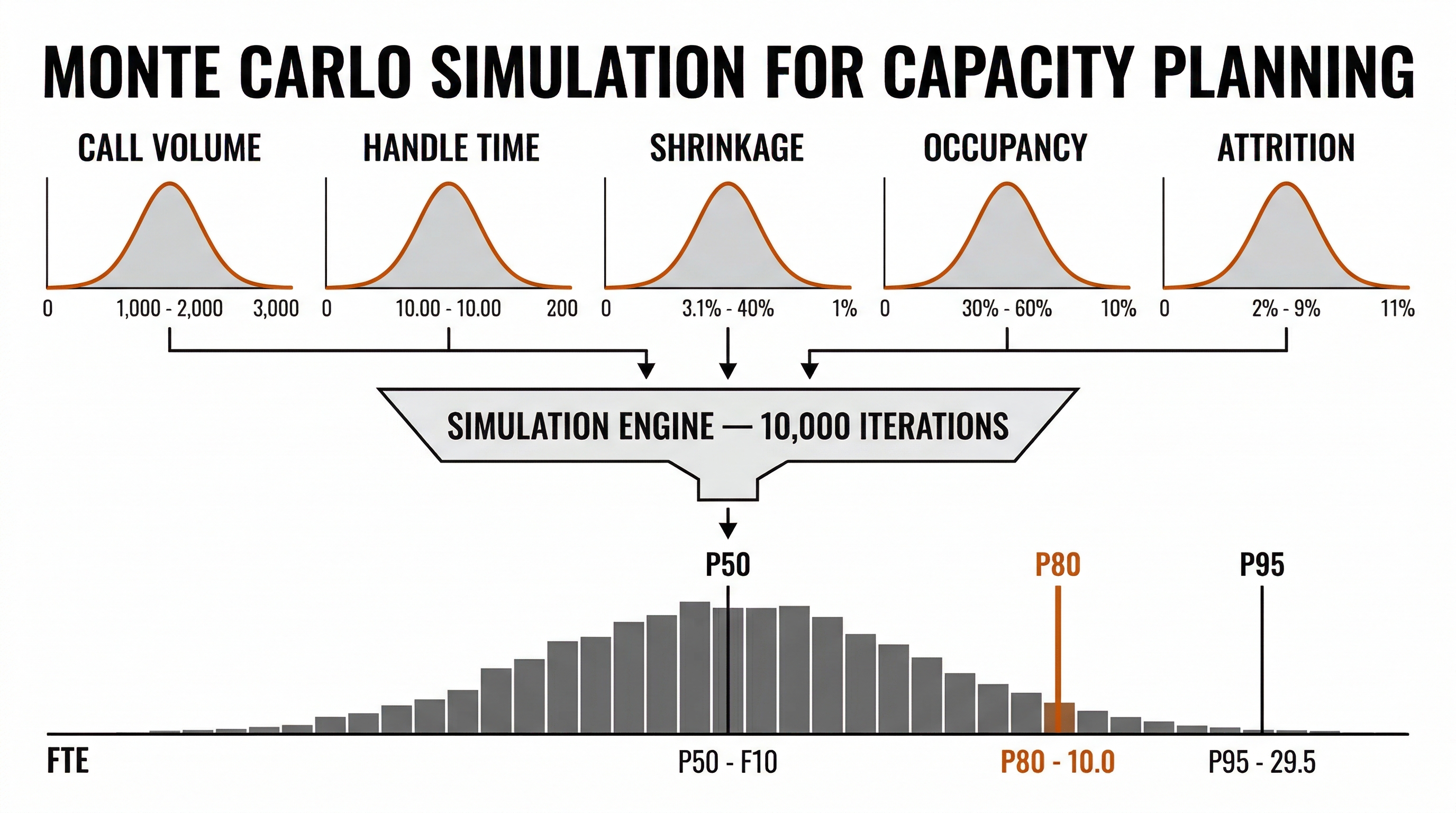
One of the key advantages of Monte Carlo simulation is its ability to simulate uncertainties in long-term resource planning. In a study on market-based generation and transmission planning with uncertainties, Monte Carlo simulation and scenario reduction techniques were applied to explicitly address demand growth uncertainties and random outages of generating units and transmission lines. This approach allowed for a more comprehensive assessment of the uncertainties involved in long-term resource planning (Roh et al., 2009).
Monte Carlo simulation has also been applied in various other domains to improve forecasting accuracy. For example, in the field of project management, Monte Carlo simulation was used to compare the performance of reference class forecasting (RCF) with other traditional forecasting methods. The study demonstrated the practical relevance of RCF by applying it to a real-life finishing construction project. By comparing RCF with baseline estimates and Monte Carlo simulation, the researchers were able to quantitatively evaluate the effectiveness of RCF in project forecasting (Batselier & Vanhoucke, 2016).
Furthermore, Monte Carlo simulation has been used in the context of streamflow drought forecasting, coal mining, COVID-19 hospital bed occupancy prediction, and plate waste forecasting, among other applications. In each of these studies, Monte Carlo simulation allowed for the incorporation of uncertainties and variability in the forecasting process, leading to more accurate and robust predictions (Dehghani et al., 2013; Fuksa, 2021; Heins et al., 2022; Kodors et al., 2022).
Monte Carlo Simulation at WFM Labs
At WFM Labs, we have pioneered a methodology that effectively integrates Monte Carlo simulation with contact center capacity planning. Our approach leverages statistical robustness and introduces a risk-rating dimension, offering a more holistic view of planning in uncertain environments. This framework provides a more resilient and adaptable alternative to traditional, often fragile, capacity plans.
The probabilistic view that Monte Carlo provides connects directly to the argument in Why Your Perfect Plan Is Already Broken: the precision of a point-estimate capacity plan is largely illusory. Building distributions around your key assumptions and modeling a range of outcomes isn’t pessimism — it’s intellectual honesty about the nature of contact center planning. The organizations that understand their planning uncertainty are better positioned to build the real-time flexibility needed to respond when actual conditions diverge from the plan.
This approach also connects to setting the right forecast accuracy target. When you’ve modeled the uncertainty inherent in your planning inputs, you have a basis for evaluating whether your forecast accuracy goals are calibrated to what’s mathematically achievable — or whether they’re aspirational targets disconnected from the actual variance in your business.
The utility of Monte Carlo simulation for enhancing forecast accuracy and capacity planning has been substantiated across a range of fields. If you have questions or want to deepen your understanding of how Monte Carlo simulation could be applied to contact center capacity planning, Ted Lango is available for a 30-minute virtual coffee chat.
References
Batselier, J. and Vanhoucke, M. (2016). Practical application and empirical evaluation of reference class forecasting for project management. Project Management Journal, 47(5), 36-51. Link
Dehghani, M., Saghafian, B., Saleh, F., Farokhnia, A., & Noori, R. (2013). Uncertainty analysis of streamflow drought forecast using artificial neural networks and monte-carlo simulation. International Journal of Climatology, 34(4), 1169-1180. Link
Fuksa, D. (2021). A method for assessing the impact of changes in demand for coal on the structure of coal grades produced by mines. Energies, 14(21), 7111. Link
Heins, J., Schoenfelder, J., Heider, S., Heller, A., & Brunner, J. (2022). A scalable forecasting framework to predict covid-19 hospital bed occupancy. Informs Journal on Applied Analytics, 52(6), 508-523. Link
Kodors, S., Zvaigzne, A., Litavniece, L., Lonska, J., Silicka, I., Kotane, I., … & Deksne, J. (2022). Plate waste forecasting using the monte carlo method for effective decision making in latvian schools. Nutrients, 14(3), 587. Link
Roh, J., Shahidehpour, M., & Wu, L. (2009). Market-based generation and transmission planning with uncertainties. Ieee Transactions on Power Systems, 24(3), 1587-1598. Link