Historical Impact of Technological Innovations on Customer Service
Historical Impact of Technological Innovations on Customer Service
Era of Technological Enlightenment
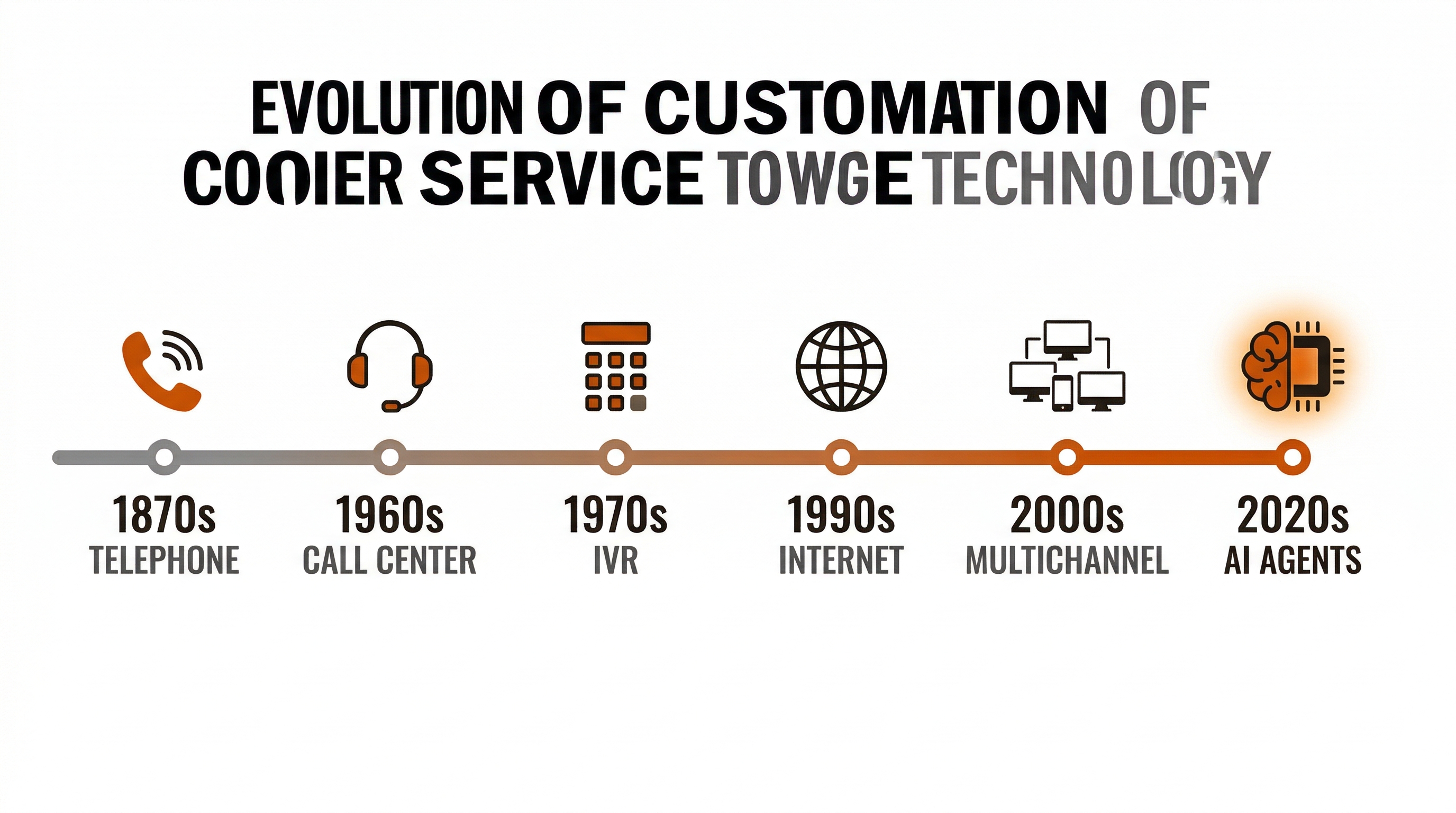
Technology has consistently been the driving force behind human progress. Cast an eye back to the late 1800s; the telephone — the first primary “service” disruptor — connected us across seas. Fast forward to the 1950s, and the microprocessor was our next ticket to ride, propelling call centers into our lives. The ride wasn’t linear; Alexander Graham Bell’s invention to the inception of the modern contact center spanned a century. Half that time, a mere five decades, the humble phone evolved into the omnipresent smartphone.
Beyond a principle, Moore’s Law stands as a testament to the inevitable pace of progress. Faster chips, innovative code, and AI-driven large language models (LLMs) are rewriting the playbook for how we define work. Quantum computing and AGI are no longer limited to the sci-fi narrative; they’re on the horizon, ready to redefine the boundaries of imagination.
What’s undeniable? Our mediums of discourse, from face-to-face chats to tapping out tweets, have shadowed tech’s exponential journey. Each ascent on this curve has mandated a shift — in business models, societal norms, and economies.
The IVR Era: A Case Study in Disruptive Technology
The history of IVR systems illustrates the pattern clearly. Interactive Voice Response technology emerged in the 1970s and expanded rapidly through the 1980s and 1990s as companies integrated these systems with computers. The promise was compelling: reduce costs by routing routine inquiries away from human agents, provide 24/7 availability, and free skilled staff for complex interactions.
The reality was more complicated. IVR systems reduced cost-per-contact for transactional inquiries, but they also introduced new forms of customer frustration — opaque menu trees, inability to handle nuanced requests, and a fundamental lack of empathy. The lesson wasn’t that automation was wrong. It was that poorly designed automation erodes value even as it reduces cost.
This lesson echoes across every subsequent wave of technology adoption in customer service. Each new capability — skills-based routing, CRM integration, omnichannel platforms, AI-powered chatbots — has followed the same arc: early enthusiasm, deployment challenges, recalibration, and eventual integration into a more mature operational model.
What Changes and What Doesn’t
Across five decades of technological disruption in customer service, certain patterns remain constant:
Transactional work migrates to machines faster than relational work. Payment processing, balance inquiries, order status checks — these moved to IVR, then to web, then to mobile. The human agent becomes progressively more focused on exceptions, complex issues, and interactions where empathy matters. The impact of AI on value creation examines this dynamic in depth: the more transactional volume is absorbed by automation, the higher the average complexity and emotional stakes of human-handled interactions.
The workforce management function gains strategic importance at every inflection point. When IVRs arrived, WFM teams had to model the deflection rates, reforecast demand, replan staffing levels, and redesign schedules. The same was true with web self-service, chatbots, and AI assistants. Each wave of automation changes the demand profile — and the WFM frameworks required to manage that demand must evolve in kind.
Speed of technology adoption outpaces organizational readiness. This is perhaps the most persistent lesson. Vendors deliver capabilities faster than organizations can absorb them. The technology itself is rarely the limiting factor — workforce capability, process redesign, and change management are.
The AI Inflection Point
The current AI wave is distinguished from previous cycles by two factors that make it genuinely discontinuous rather than incremental.
First, the scope of automation potential is broader. Previous technologies could automate narrow, well-defined tasks. Large language models can engage in open-ended conversation, draft responses, synthesize knowledge, and reason across contexts. This puts a far larger portion of contact center work within the theoretical reach of automation.
Second, the pace of improvement is faster. IVR technology improved incrementally over decades. AI capabilities are advancing at a pace that makes three-year workforce plans feel like guesswork.
Understanding where your organization sits on the maturity curve is critical to navigating this moment. Organizations that are still operating legacy WFM practices — static scheduling, manual real-time management, limited use of analytics — face a different set of priorities than those already operating sophisticated human-AI collaborative workflows.
Looking Ahead
In reflecting on the transformative journey of technological innovations, it’s clear that each leap has significantly impacted customer service domains, especially contact centers. As we transition into a new era marked by advanced AI and quantum computing, adapting and leveraging these technologies is imperative for staying ahead. The question is no longer whether AI will transform the contact center workforce — it’s whether organizations have the frameworks, maturity, and strategic intent to manage that transformation.
At WFM Labs, we foster a collaborative environment where professionals can discuss, analyze, and strategize on the intersection of emerging technologies and contact center operations. Our goal is to drive forward-thinking discussions that lead to actionable insights and robust solutions for modern contact centers.
We invite you to join WFM Labs, contribute to meaningful discussions, and collaboratively work towards redefining customer service excellence in the face of technological advancements.