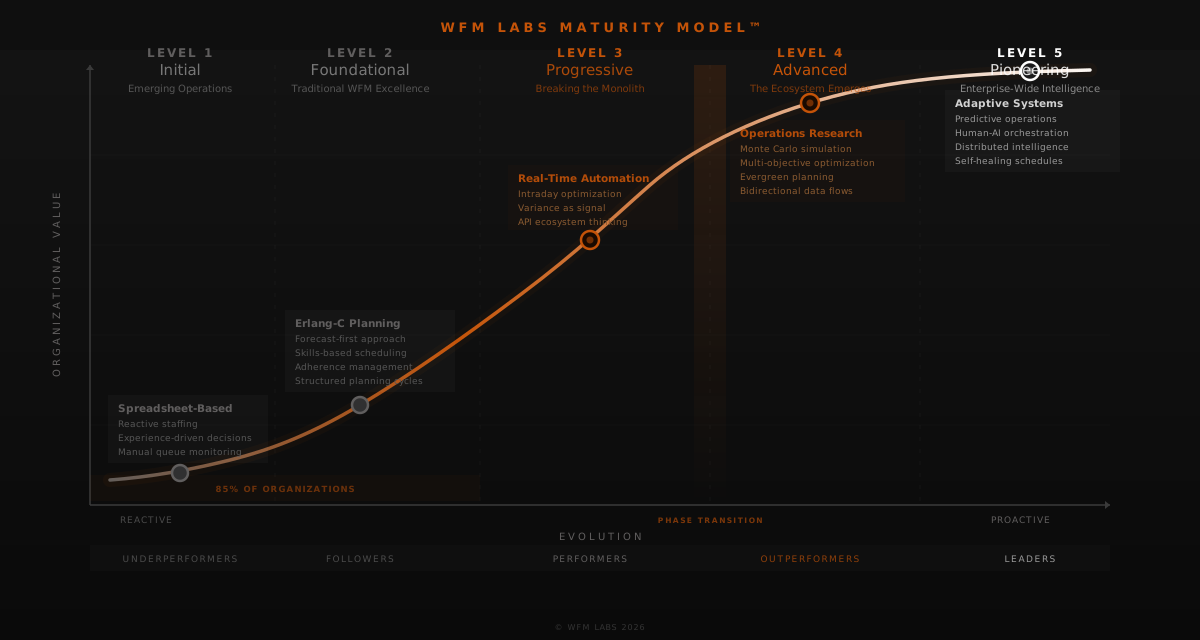
Five Levels of Workforce Intelligence
A practical framework for understanding where your organization stands today and what it takes to advance. Applicable to any function managing knowledge workers — across industries and functions.
85% of organizations operate at Level 1 or 2. The maturity model isn't about judgment — it's about clarity. Understanding where you are determines what investments will actually move the needle, and which ones are premature.
Where It Starts
The starting point for organizations lacking formal workforce management practices. Supervisors monitor queues personally, staffing adapts reactively to changing conditions, and decisions are based on experience and intuition rather than data.
- Spreadsheet-based tracking without optimization
- Direct leadership with personal queue monitoring
- Experience-based decision-making
- All-hands collaborative culture
- Agility and speed of response
- Customer intimacy and team unity
- Direct feedback loops
- Entrepreneurial problem-solving
Volume increases beyond 50–100 workers, service inconsistency becomes visible, leader burnout from constant firefighting, cost pressures from reactive staffing decisions.
Where the Majority Operate
Traditional workforce management mastery through professional processes, dedicated teams, and comprehensive platforms. This is where most organizations achieve real value — predictable service delivery, cost control, and data-driven decisions.
- Comprehensive WFM platforms (forecasting, scheduling)
- Structured planning cycles — weekly, monthly, annual
- Skills-based scheduling across channels
- Adherence management with real-time monitoring
- Historical data analysis for trend identification
- Forecast-first: volume and handle-time accuracy
- Traditional shift bidding based on seniority
- Defined shrinkage planning (training, breaks, coaching)
- Performance dashboards and reporting
- Intraday manual adjustment when variance occurs
Intraday volatility that manual intervention can't keep up with, omnichannel complexity outpacing scheduling models, remote workforce management challenges, rising expectations for real-time responsiveness.
The Automation Inflection Point
The recognition that traditional platforms alone cannot address real-time complexity. Purpose-built automation platforms begin operating alongside core WFM systems, and the shift from vendor lock-in to ecosystem thinking begins.
- Continuous performance monitoring every few seconds
- Dynamic activity management without manual intervention
- Intelligent overtime avoidance through predictive modeling
- Multi-skill optimization using real-time algorithms
- Automated variance response as deviations occur
- Planning-focused → execution-focused roles
- Acceptance that forecasts will be wrong; adaptation matters
- Building organizational trust in automation
- API fluency and technical integration skills emerge
- Data democratization across functions
Variance becomes fuel rather than the enemy. In a 1,000-worker operation, automation harvests 847 micro-gaps daily — equivalent to 42 hours of recoverable capacity. Training, coaching, and cost savings flow from capacity that was previously invisible.
Levels 1–3 improve within the same paradigm.
Level 4 requires a structural redesign.
Where Competitive Advantage Is Built
Specialized Operations Research planning engines exchange bidirectional data with core WFM platforms, creating intelligent feedback loops. Planning becomes evergreen — continuous automatic updates replace seasonal cycles. This is where the question fundamentally changes.
“You cannot reach Level 4 by doing Level 3 better. The organizations that make the jump do so by redesigning their workforce planning function around the blended workforce.”
- Ensemble prediction models selecting optimal performers
- Monte Carlo simulation and stochastic optimization
- Risk-aware capacity buffers
- Multi-objective optimization: cost, CX, EX simultaneously
- Prescriptive analytics recommending specific actions
- Beyond call data: business metrics, weather, economic indicators
- HR systems (skills, tenure, performance)
- Financial connections (revenue per transaction, cost structures)
- CRM integration (customer value, interaction history)
- Bidirectional data flow across all systems
The Adaptive Organization
Complete integration of workforce management into enterprise decision-making. An adaptive ecosystem that optimizes human potential while remaining ready for emerging capabilities. AI augments rather than replaces — and multi-objective optimization determines the ideal routing for every interaction.
Customer journey intelligence that senses demand before it arrives. Self-healing schedules. Real-time demand sensing across digital and business systems.
Multiple systems of record orchestrated without duplication. Dynamic source mapping. Contribution without claiming ownership.
Global talent pools, dynamic routing matching needs with worldwide capabilities, AI-assisted rapid skill development, performance tracking that values human connection.
Predicting customer needs versus reacting to contacts. Enhancing human capabilities versus chasing trends. Quantifying human value versus guessing. Holistic optimization versus siloed improvement. Building on human solutions for the work that matters most.
Where Are You on the Journey?
Understanding your current maturity level is the first step toward meaningful transformation. Take our interactive assessment or join the community to learn from practitioners at every level.